
Combatting Toxicity in League of Legends
Using cognitive principles to encourage positive player interactions and reduce in-game toxicity in League of Legends.
Duration
4 months
My Role
UX Researcher, UX Designer
Team
1 Project Advisor
7 Designers
Methods
Contextual Interviews, Surveys, Wireframing, Prototyping, Usability Testing, System Usability Scale
Responsbilities
During the research phase, I conducted secondary research and expert interviews on gaming toxicity. I then pitched three potential ideas to combat toxicity, then later refined the concept for the League of Legends values system. I also prototyped the feature, and conducted usability testing and contextual interviews with League of Legends players.
BACKGROUND
League of Legends is one of the popular online games in the world.
With over 150 million registered players and boasting a large esports presence, it is one of the most successful multiplayer online games today.

PROBLEM
Player-to-player toxicity is widespread in League of Legends.
74% of players in multiplayer games, including League of Legends have reported witnessing or experiencing toxic behavior, from in-game tampering to harassment and predatory behavior.
Players rationalize toxicity as an inherent, natural part of gaming, but research has shown that this type of behavior has long-term negative impacts that extend beyond online gaming.

OPPORTUNITY
Research shows that encouraging positive behavior is more effective in sustaining long-term behavioral changes than discouraging negative behavior.
So, how might we mitigate gaming toxicity by promoting positive player interactions in-game?
FINAL DESIGN
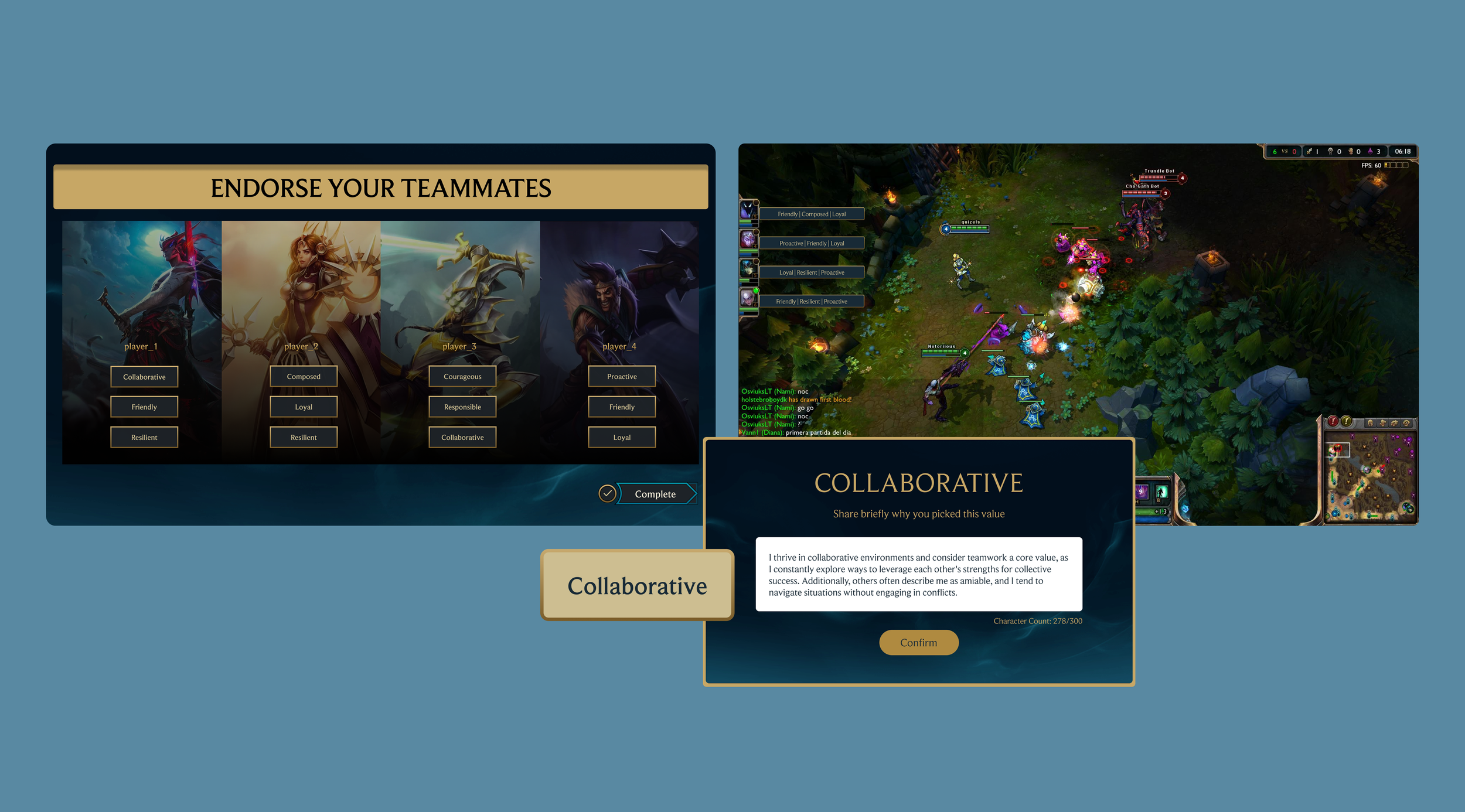
Players choose 3 values they wish to grow in while gaming.
These values include resilience, collaborativeness, and friendliness. Players then explain why these values are important to them.
Players endorse teammates for modeling positive in-game behaviors.
After each match, players select all of the player values that their teammates displayed during the game.
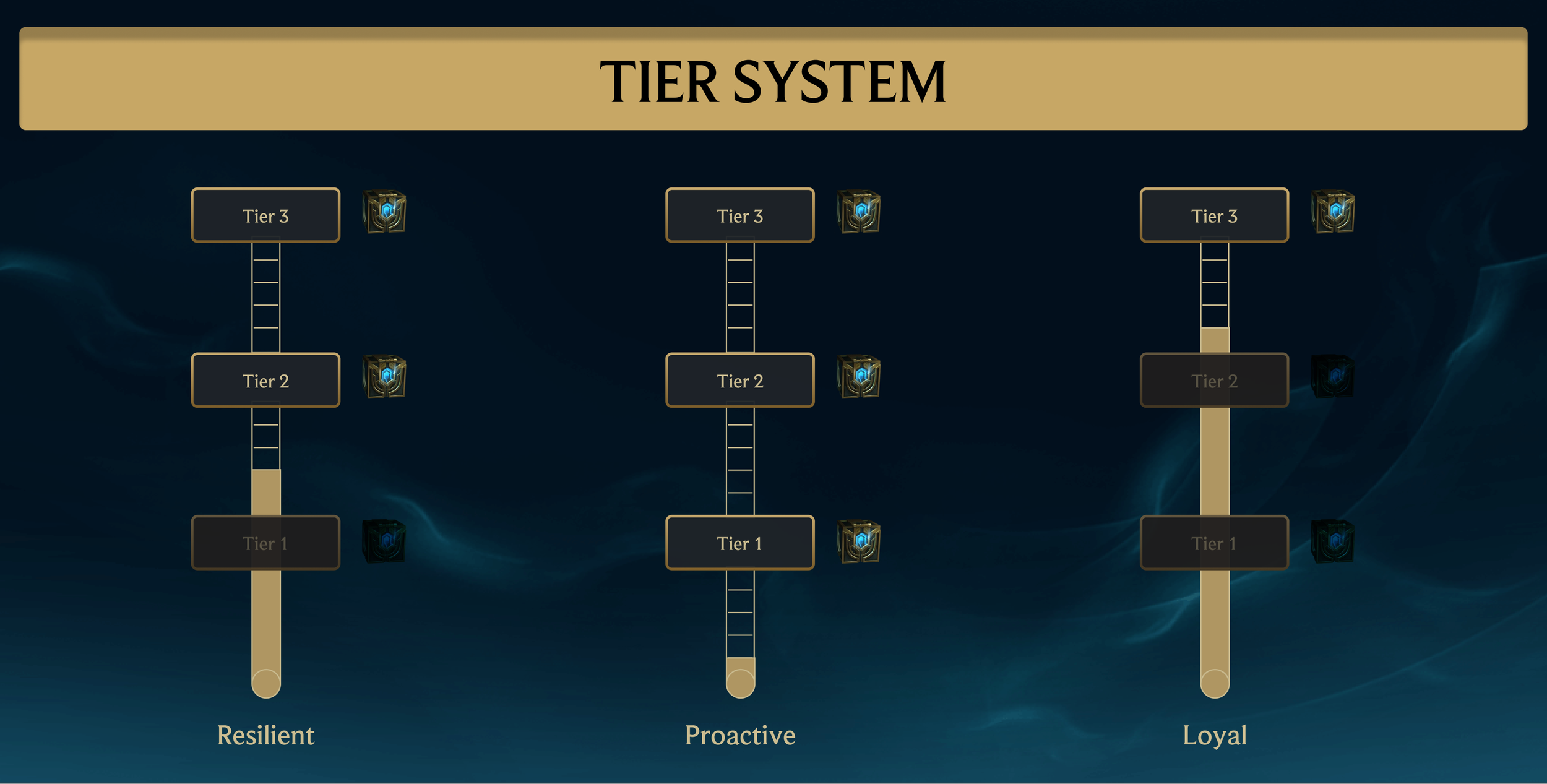
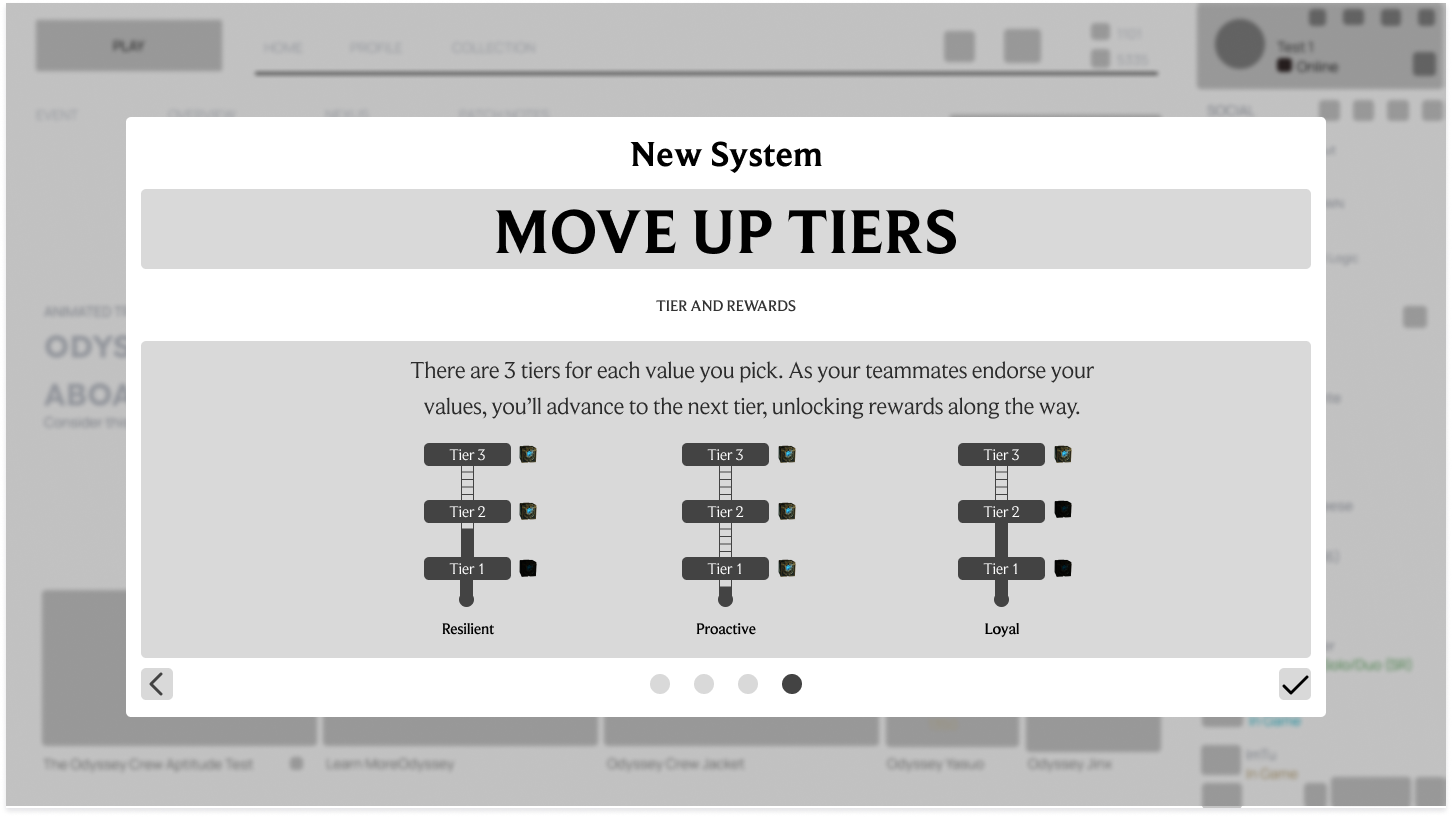
Players get rewards for progressing in their chosen values.
As players accumulate endorsements from their teammates, they gain experience in those values to unlock cool rewards.
There is a pervasive culture of player toxicity within League of Legends.
USER RESEARCH INSIGHTS
Toxicity is normalized in gaming
A lot of players feel helpless when reporting toxic behavior because it is so common and there are few serious consequences enforced.
Online anonymity feeds detachment
Having an online identity, that is entirely separate from who the player is in real-life, enables them to engage in “out-of-character” behaviors that might not arise as much outside of online settings.
Intrinsic motivation is more effective than extrinsic motivation
Motivation that comes from within the player, and is not so focused on punishing negative behavior, is much more effective in sustaining prosocial behaviors long-term.
PREVIOUS ITERATIONS
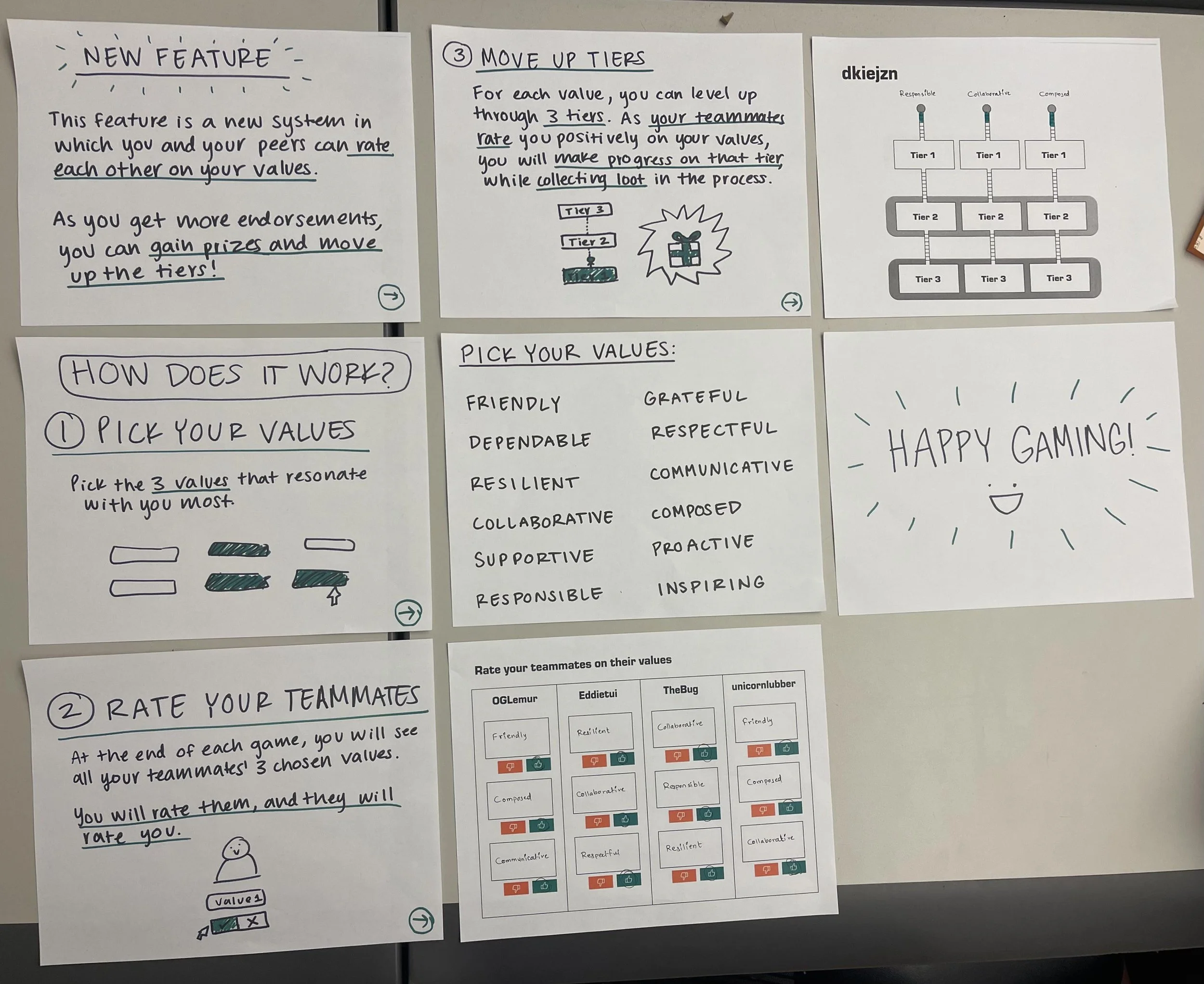
High-stakes game environment, overwhelming endorsement screen.
Participants rarely looked at values on the screen. Most of the time their attention was occupied by the game, due to its high-intensity nature.
Additionally, the teammate endorsement screen was overwhelming. The sheer number of values to select from on the screen slowed down the speed at which they could complete value endorsement.
High-stakes game environment, overwhelming endorsement screen.
Players associated their chosen values with both gameplay and life outside of the game. ”Resilience” was one of the most popular values, due to its perceived importance in playing well during games.
Some players thought about how they could better exhibit their values for their next game. They thought that these features could prove very motivating for gamers to create a more positive environment.
SURVEYS
Designed surveys to collect data on player sentiments related to their value during and outside of gameplay.
We had participants fill out a survey prior to the study in order to record their chosen player value. We also had them fill out a short post-game survey after each game, in order to show snapshots of player behavior and reflection after each game.
NEXT STEPS
Extended this project to a longitudinal study to test our system with a more diverse player pool
One of the biggest constraints of the initial project timeline was not having the time to test the values system with a bigger participant pool. In the next few months, we recruited League of Legends players across the US to try out our system during their matches and tell us their thoughts and takeaways through weekly interviews.
Writing a research paper to showcase our findings and how developers might facilitate healthier gameplay experiences
With advising from Geoff Kaufman, we’ve collected data from the longitudinal study and are now planning to write a research paper that encapsulates our insights.
